


In numbers Through the lens Video
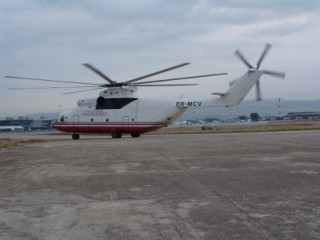
The heavy Mi-26 transport helicopter is ntended to transport various cargo and jquipment, to evacuate the ills and injured and to land troops. On the 28th of November, 1967, by the Government order it was desided to develop the helicopter, able to carry cargo with the mass of up to 20 tons at the range of up to 400 km. The classical single-rotor scheme with the main rotor diameter of 32 m was chosen. It was decided to use two D-136 turboshaft engines of V.A. Lotariov Design Bureau as power plant. In August, 1971, development of the helicopter, designated as Mi-26 has began. Leading scientific centers of the country such as the TsAGI, Ul, VIAM, NIAT, TslAM and others were involved in the Mi-26 development.
For the first time in the helicopter manufacturing history a 8-blade main rotor was developed for the Mi-26. The designing of the helicopter was mostly finished in 1975, and on the 31st of October the first experimental Mi-26 was rolled out and made its maiden flight (test-pilot G.R.Karapetian) on the 14th of December 1977.
The state tests were completed in August, 1980. On the 25th of October the first serial helicopter, manufactured at the Rostov helicopter plant, made its first flight. In total, before 1997, 276 of Mi-26 helicopters were manufactured in Rostov. Besides military versions, in 1983, the civil version of the helicopter - Mi-26T, with the additional radio communication, navigational and special purpose equipment, and without number of special systems and equipment was also developed. In 1995 this version was certified under Mi-26TS designation. The Mi-261 helicopters are used by the EMERCOM of Russia. At the end of the 1990s the specialized fire-fighting Mi-26TP helicopter able to take aboard up to 15 tons of foam fluid in the special external suspended container was designed. In 1999 the red-white fire-fighting helicopter, also equipped with modern thermal vision devices on gyro-stabilized platform, was displayed at the MAKS-99 airspace show.
To use transport Mi-26Ts for fire-fighting special technologies and equipment were developed by the experts of the Scientific and Technical Department of the EMERCOM. Particularly, the Mi-26T can be equipped with the VSU-15 water drop system which is a «sack» made of strong parachute fabric and is able to carry up to 15 tons of water. It is designed to be filled within several seconds: the helicopter is hovered above any reservoir, the winch lowers the water drop system and half a minute later the VSU-15 is already completely filled up. Especially it is necessary to point out that VSU can be filled automatically from any reservoir with depth not less than 0.5 m. The tests of the VSU-15 at Mi-26T were carried out by the pilots of the Falcon Airlines in the Krasnodar area in 1999. Experts noted the work fast rate, high water-drop accuracy, reliability and profitability of the system. At the end of April, 1999, the VSU-15 were first shown to Russian and foreign experts during the EMERCOM of Russia rescues display trainings held at the Sochi port area.
Upgrading of the existing Mi-26 helicopters fleet is now being done. In the terms of upgrading, new avionics (the information - control cockpit field equipped with screen indicators) which allow to reduce flight crew up to two crew-members are installed. The thermal-vision equipment ensuring the all-day and all-weather combat application, and also satellite navigation system receiver are included into onboard electronic equipment structure.
Onboard systems and equipment. The navigation complex provides all-day all-weather flight. At the front fuselage part the 7A813 "Thunder-storm" weather radar is installed.
The helicopter is equipped with the winch with a cable for the cargo suspension, onboard TV equipment with three video cameras. The cargo handling equipment includes the rear cargo ladder with removing-release hydraulic system, two telfers with carrying capacity up to 2.500 kg and the winch for 500 kg force for cargo in the cabin moving, floor with roll beam.
Technical specifications
| DESIGNER | OKB Mil |
| COUNTRY | Russia |
| TYPE |
Firefighting helicopter
|
| CREW | 5 |
| POWER-PLANT | Two turboshaft engines Progress D-136 |
| Power, h.p. | 2x11.393 |
| DIMENSIONS | |
| Length, m | 33,73 |
| Main rotor diameter, m | 32,00 |
| Tail rotor diameter, m | 7,61 |
| Height, m | 8,15 |
| WEIGHT | |
| Maximum take-off, kg | 56.000 |
| Normal take-off, kg | 49.650 |
| Empty, kg | 28.600 |
| Internal fuel, kg | - |
| Warload, kg | - |
| Payload, kg | |
| - freight in cabin | 20.000 |
| - with on hook | 20.000 |
| PERFORMANCE | |
| Maximum speed, km/h | 295 |
| Cruising speed, km/h | 255 |
| Range, km | 2.000 |
| Ferry range, km | - |
| Combat range, km | - |
| Service ceiling, m | 6.500 |
| Static ceiling, m | 1.520 |
| Rate of climb, m/s | - |
| Maximum overload, g | - |
| ARMAMENT | Doesn't have (defensive). |