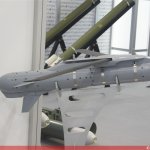
.jpg "PGB128 Precision gliding bomb © Konstantinos Panitsidis")
In numbers Through the lens Video
PGB128 is conceived as air-to-ground weapon for stationary targets. It shall be released from a Low and Medium Speed aircraft and carried by NATO standard 14'' hardpoint as specified in MIL-STD-8591.
Spatial arrangement of the systems that make up the PGB128 bomb.
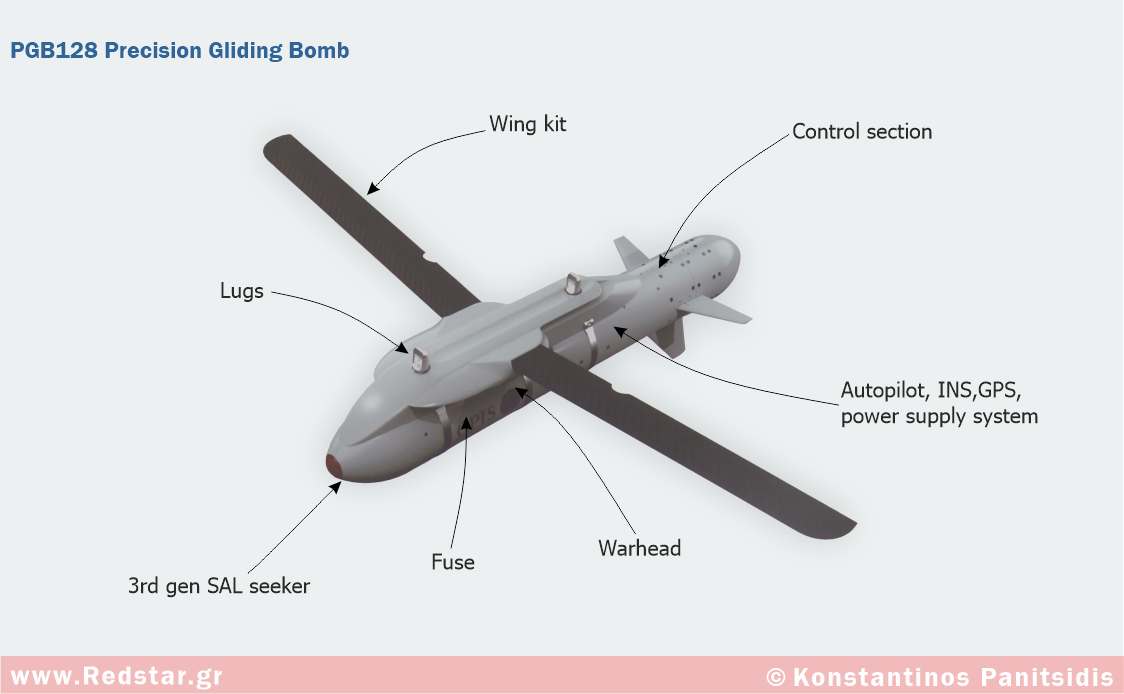
Main features:
- Three all-flying surfaces are used for bomb control
- New aerodynamic design encompasses an increased lift-to-drag ratio of 8
- The optimal angle-of-attack for maximum lift-to-drag ratio is 8 degrees
- The minimum range is 15,8 km (the minimum release altitude is 2.000 m, the minimum release speed is 52 m/s)
- The maximum range is 60 km (the maximum release altitude is 7.620 m, the maximum release speed is 9 m/s)
-Maximum vertical dive speed at sea-level is 206,9 m/s
Technical specifications
| DESIGNER | EDePro |
| COUNTRY | Serbia |
| TYPE |
Precision gliding bomb
|
| Aircraft-bearer (aerial means) |
UAV and aircraft
|
|
DIMENSIONS
|
|
| Length, m | 1,053 |
| Wing span, m | 1,49 |
| Diameter, m | 0,13 |
|
WEIGHT
|
|
|
Maximum bomb weight, kg
|
30 |
|
Warhead weight, kg
|
20 (18) |
|
Weight of explosive, kg
|
- |
|
PERFORMANCE
|
|
|
Minimum range, km
|
15,8 (5) |
|
Maximum range, km
|
60 (25) |
|
Minimum permissible height of use of the air bomb, m
|
2.000 |
|
Maximum permissible height of use of the air bomb, m
|
7.620 |
|
Minimum permissible speed of the aircraft before using the air bomb, m/s (km/h)
|
≤60 (≤216) |
|
Maximum permissible speed of the aircraft before using the air bomb, m/s (km/h)
|
206,9 (744,84) |
|
Circular error probable, m
|
1,5 (until 3,0 m) |
|
Warhead type (depending on the mission)
|
hermobaric, high-explosive fragmentation, high-explosive |
|
Contact (fuse)
|
- |
|
Guidance system
|
It has an inertial system and a satellite system. Semiactive laser guidance |
Photos PGB128