


In numbers Through the lens Video
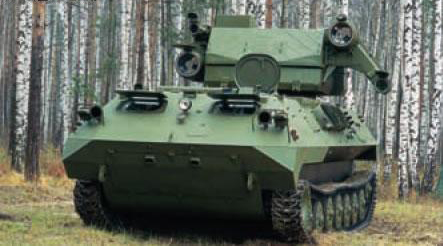
In 1988 the bureau NPO "Astrofizika", designed and developed a self moving, autonomous system for detecting and identifying various kinds of Radio-Bio-Chemical pollution, named Dal.
For detecting and measuring various agents, chemicals or radiation levels, generally you have to be on location, which is not so simple due to possible enemy fires, but also a great delay in the threat recognition. Also this way you have only a local picture of the pollution, not a more general one.
System Dal allows for the detection and recognition of various pollution threats, even with minimal concentrations from a distance without the need for it to enter the suspected area.
During the research from NPO Astrofizika, a great number of methods for distant detection and identification in the atmosphere, through laser usage, were tested in a wide range of bands.
As a result, there was a database of the spectral identification patterns of many agents, created. The tests executed, based on spectrum and interactions with the environment, were successful.
The entire system was placed on a tracklaying amphibious vehicle, under the name KDXR-1N and was incorporated in the Armed Forces. Te first two production vehicles were delivered in 1990. It can detect toxic agents in the environment, like VX, over areas up to 30 sq. klms. It can operate in autonomous mode for a period of 3 hours.
The system builds a detection map of the polluted area. On top of the vehicle, there is a turret installed, with the ability of 360 degrees turn, which scans the surrounding space in all possible angles and ranges. The results are passed to the onboard computer witch then transmits them, in real time, to a central command computer.
The system is equipped also with sensors for detecting chemical agents and radiation levels (like dosimeter IMD-21B, autonomous gas detector GSA-12, semi-automatic gas detector PGO-11 and a series of other devices for samples gathering and analysis, like the KPO-1, which allow KDΧR 1Ν to execute a wide variety of missions for the detection and identification of Radio-Bio-Chemical hazards over great areas.