


.jpg "Pchela Unmanned aerial vehicle. First flight: 1990 © Konstantinos Panitsidis")
In numbers Through the lens Video
Pchela-1 Remotely piloted aerial vehicle operating as part of the Stroi P support system is designed aerial reconnaissance missions far behind adversary forward battle areas.
Flight control: radio controlled from a ground-based remote control station. The UAV has the ability to install a thermal imaging camera.
The power plant consists of one two-stroke, two-cylinder engine of the DVS P-032 type with a pusher propeller in a ring.
Boosting method: catapult-assisted using two gunpowder boosters. Landing method: on command using a parachute shock absorbing system.
Three-view drawing
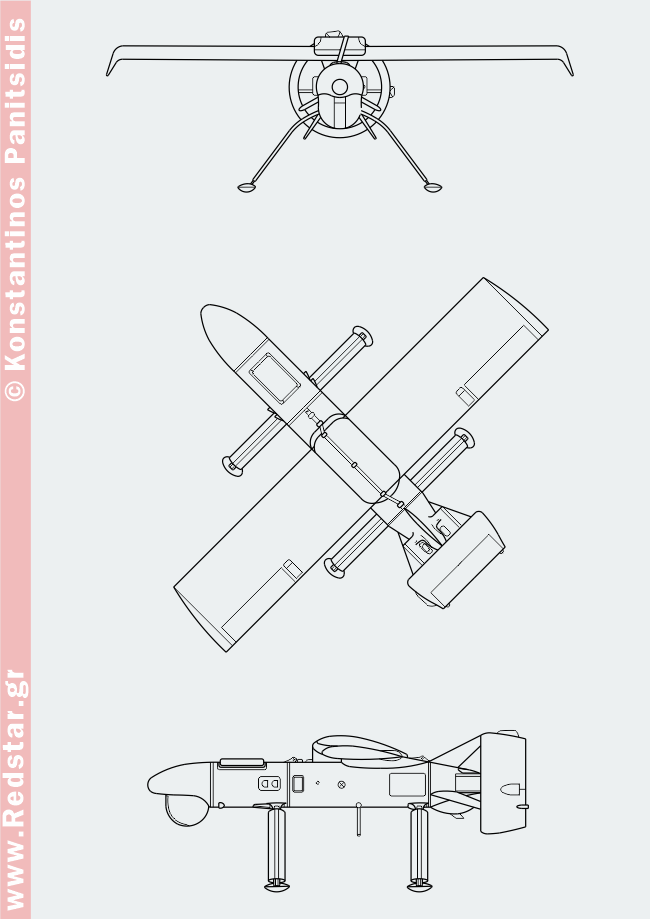
Technical specifications
| DESIGNER | OKB Yakovlev |
| COUNTRY | Russia |
| TYPE | UAV aerial reconnaissance |
| CREW | - |
| POWER-PLANT | P-032 two-stroke internal combustion engine |
| Power, h.p. | 1x132 |
| DIMENSIONS | |
| Length, m | 2,630 |
| Height, m | 1,12 |
| Wing span, m | 3,250 |
| Wing area, m2 | - |
| WEIGHT | |
| Maximum take-off, kg | 138 |
| Normal take-off, kg | - |
| Empty aircraft, kg | - |
| Internal fuel, kg | - |
| Payload weight, kg | 10 |
| PERFORMANCE | |
| Maximum speed, km/h | 180 |
| Cruising speed, km/h | 100 |
| Rate of climb, m/s | - |
| Service ceiling, m | 100 - 2.500 |
| Range, km | - |
| Combat range, km | 50 |
| Endurance, h | up to 2 |
| Preparation time for launch, min | 35 |
| Operational temperature range, oC |
-30....+50 |
| TV equipment detection height: an (armored) vehicle, m |
400 |
| Number of UAV uses | 10 |
| ARMAMENT | Doesn't have (defensive). |