


In numbers Through the lens Video
In recent years, China has published information about new developments in the field of fighter aircrafts, but not much attention was given to the development of strategic bombers. Only in 2007 the military leadership of aviation has officially confirmed the existence of strategic bomber H-6K (a heavily modernized Soviet Tu-16). Detailed information about the strategic bomber H-6K is still minimal, but considering that the original version of the Tu-16 was created in the early 1950's, it is relatively easy to make assumptions on it. All versions of H-6, require replacement with a new modern design, but China has none.
The Chinese Air Force received six modernized strategic bombers Xian H-6K, in early 2011. The strategic aviation of the Chinese today is up to 200 type H-6 bombers, of which about half are active. According to unofficial information, the Air Force intends to acquire up to 20 type H-6K bombers. Unknown remains whether the existing H-6 will be modernized at H-6K level.
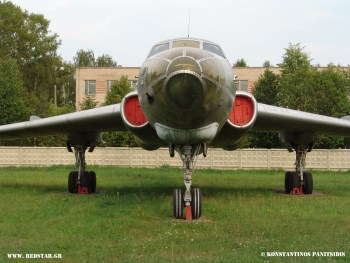 |
| Tu-16 Badger, Monino 2007. |
In September 1957, the Soviet Union adopted a program of support and development of the Chinese armed forces in order to strengthen the Chinese Air Force, under which it delivered a number of medium strategic bombers Tu-16 Badger. However, with the increased tensions between the USSR and China, it stopped aircraft deliveries, so the Chinese industry started to evolve its bomber, based on the Tu-16 Badger, from Xian Aircraft Company and Xian AeroEngine Corporation. In December 1968, flew the first Chinese bomber H-6 I Badger. Other versions, as the H-6 Badger II and the H-6 C III Badger and an export version, the B-6A were developed, but they did not differ from the standard version of the Tu-16 Badger.
The Chinese H-6H bombers have not great potential as strategic bombers to nuclear strike role. Firstly, the subsonic speed, the lack of modern designs and the non-compliance with modern stealth technology specifications, do not allow the bombers to penetrate the air defenses of the opponent.
Secondly, until 2006, China had no long-range missiles, like cruise missiles. Instead it used missiles YJ-63, carried by the H- 6H aircraft. The combination of H-6H and YJ-63 allows attacking of targets at distances up to 200 km. Thus the Chinese aviation developed a new version of the H-6K (based on H-6H), a capable strategic bomber.
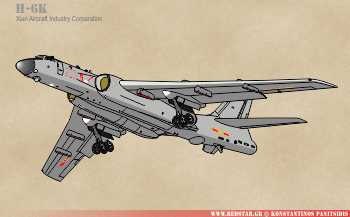
It is an evolution of the Tu-16, equipped with engines D-30KP-2 instead of WP-8 (a copy of the Soviet AM-3M), with modified fuselage board and improved electronics, with a capacity of carrying up to six type CJ-10A missiles (copy of the Kh-55). It first flew on January 5, 2007. Integration in the Chinese Air Force arsenal in 2011.
The Chinese bomber Xian H-6K is a copy of the Russian Tu-16. This version is the most modern, and has a new turbine bypass turbofan engine D-30KP-2 with 12.000 kg of thrust each, reinforced fuselage structure using synthetic materials, larger air-intakes, a new dielectric cone for hosting a new radar, upgraded cockpit and redesigned external weapons platforms. This new edition of the Chinese bomber can carry up to six cruise missiles CJ-10A with an effective range of 2.500 km. The range of H-6K with full weapon load (six missiles under the wing) is estimated at 3.500 km. Its speed is up to 1.050 km/h.
The aircraft improvements: Xian H-6K

Powerplant:
In 2011, China received the first batch of D-30KP-2 engines, from Saturn after a contract was signed between Rosoboronexport and China for the supply of 184 (including 55 type D-30KP-2) engines, with deliveries to be completed by 2015. The contract also provided for the technical support from the manufacturer during the warranty period. In 2013, 60 engines were to be delivered, and in 2014-2015 the rest (about 72 engines).
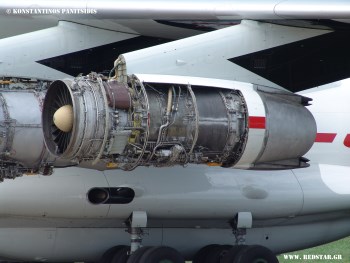 |
| D-30KP-2 Turbofan engine, static exhibition MAKS-2007 |
D-30KP-2 The engine D-30KP-2 is a turbofan engine, intended primarily for transport aircrafts of the class of IL-76M, IL-76T and IL- 76TD. The engine D-30KP-2 is fully interchangeable with the engine D-30KP. Since the last deliveries of the engine, China is trying to evolve a proprietary turbofan engine WS-18 based on D-30KP-2 (it is essentially a copy of the D-30KP-2).
The engine development took place in 2007 by the Chengfa (former 420 factory in Chengdu). Until now little information is available at what stage is the testing.
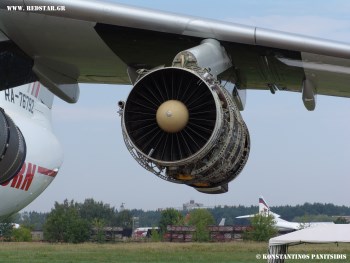 |
| D-30KP-2 Turbofan engine, static exhibition MAKS-2007 |
| Take-off thrust (Η=0, Mach=0, th+15 oC), kgf | 12.000±1% |
| Specific fuel consumption at take-off, kg/kgf*h (Η=0, Mach=0 th+15 oC) take off mode | 0,510 |
| Bypass ratio | 2,3 |
| Length, mm | 5.448±10 |
| Diameter, mm | 1.560 |
| Dry weight, kg | 2.650+2% |
| Maximum weight, kg | 2.953+2% |
| ARMAMENT |
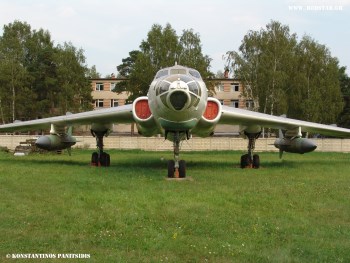 |
| Tu-16 K Badger, with two missiles mounted on external suspensions, Monino Museum 2007. |
The weaponry of H-6K includes most of the Chinese weapon arsenal, and also the latest H-6K constitutes an excellent weapons platform with a total of 6 external load suspension points. The weapons payload in standard configuration, is approximately 10.000 kg, (maximum 12.000 kg).
| YJ-62 (export version C-602) |
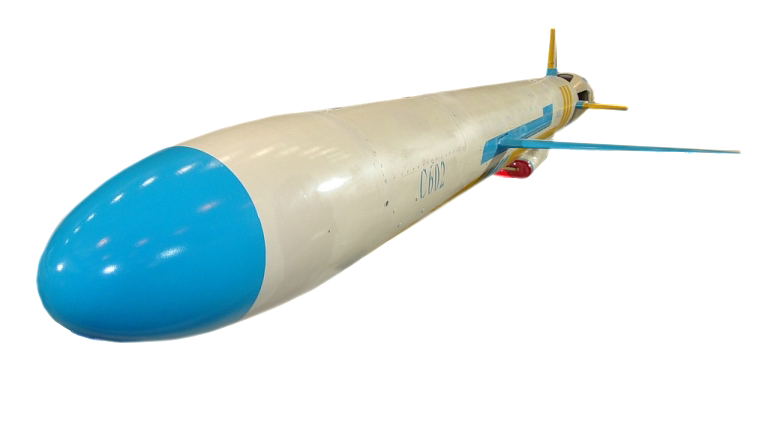 |
| Tactical Chinese medium-range anti-ship missile, intended to attack ships of various types. The missile can be transferred by aircrafts or ships and submarines in containers. The projectile incorporates some elements mainly from the Kh-55 (which were acquired from Ukraine in 1999-2001) and the Tomahawk. The missile is equipped with a small turbofan engine WS-500. Engine weight is 200 kg, the maximum thrust is 510 kg. The naval version of the missile is equipped with a solid fuel engine. |
| YJ-82 (export version C-802) |
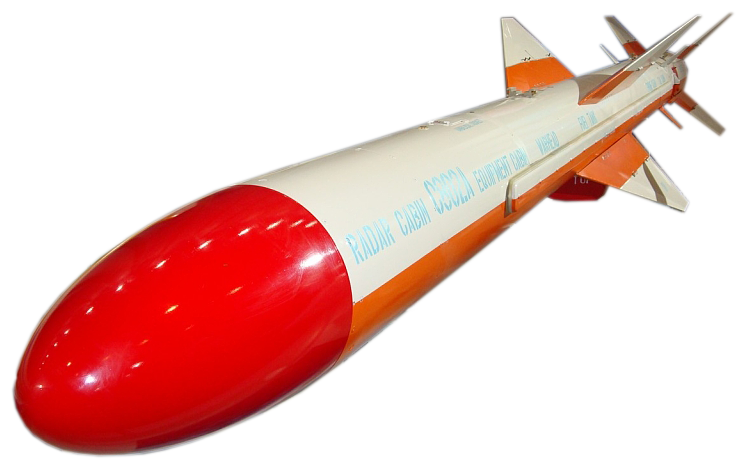 |
| Tactic medium-range missile, which evolved to attack ships. The first official appearance of the rocket was in 1989. Missile C-802 differs from its predecessor C-801A. The C-802 bears a turbine, instead of solid fuel engine, such as version C-801A. Thanks to replacing the engine, the range of the missile is now 120 km. Apart from China, the missile has been exported to countries such as Algeria, Bangladesh, Indonesia, Iran, Pakistan, Thailand and Myanmar. |
| Artist's rendering of the CJ-I0 / CJ-I0A missile |
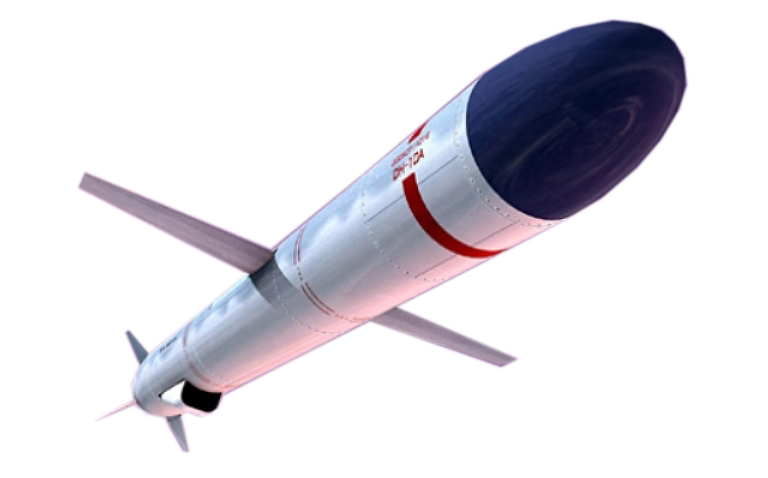 |
| Cruise missile CJ-10 has a range between 1.500 and 2.000 km (according to other sources 2.200 2.500 km). These missiles are copies of Soviet Kh-55, but are capable of carrying a nuclear warhead. They can reach speeds of 2.5 mach, but with reduced accuracy, as their guidance is based on inertial navigation system, with a possible satellite aiding by the Chinese satellite navigation net “BeiDou”. The latter, however, at present isn't in operationable state and it is unknown if China can direct the CJ-10A by satellite. |
| YJ-12 |
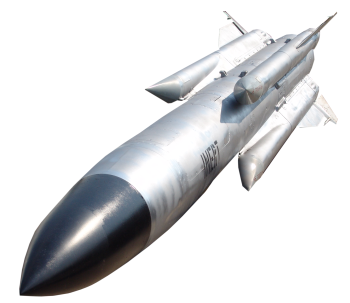 |
| The development of supersonic anti-ship missile YJ-12, began in the early 90's. In its evolution participated agencies such as the China Sea Eagle Electromechanical Technology Academy (CHEMTA), the TriRiver Aerospace Industrial Group, consisted of governmental agencies China Aerospace Science and Industry Corporation (CASIC). The project was established in early 2000, and in 2005 began production at a slow pace. The missile was seen for the first time being transferred from a naval cooperation aircraft H-6G. Externally, the projectile is similar to the Russian missile Kh-31 (version MA-31, aerial target) or the American airspace target GQM-163A Coyote. |
| YJ-91 ( factory designation KR-I) |
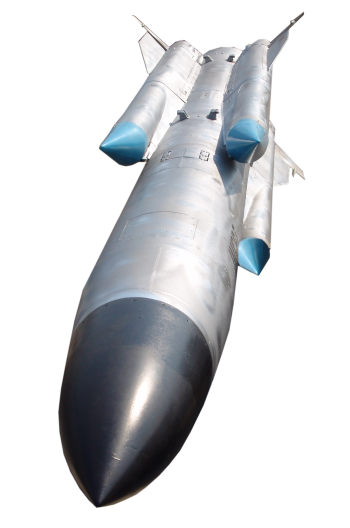 |
| Chinese version of the Kh-31 / Kh-31P, developed by the company "Hongdu Aviation Industry Corporation" to equip aircrafts such as the JH-7, J-8B, Su-27, Su-30, J-10. Essentially, it is a copy of the Russian AntiRadar missile Kh-31P (during 2002-2004, according to foreign media reports, China bought about 200 Radar missiles Kh-31P, to arm the Su-30MKK). Moreover, there are reports that the Chinese are trying to copy the anti-ship missile “Moskit”. |
The future of the new H-6K Inarguably the H-6K (deep modernization), is the latest version of the family of H-6 (Tu-16) incorporating systems that are found in modern bombers.
It is practically a new design, leaving behind previous versions like the H-6H and H-6M, which until recently ware considered as the most advanced of the specific design.
The H-6K, by many is regarded as the predecessor of the new strategic bomber, incorporating many of the systems, such as the cockpit configuration or the engines that will equipp the new bomber (stealth).
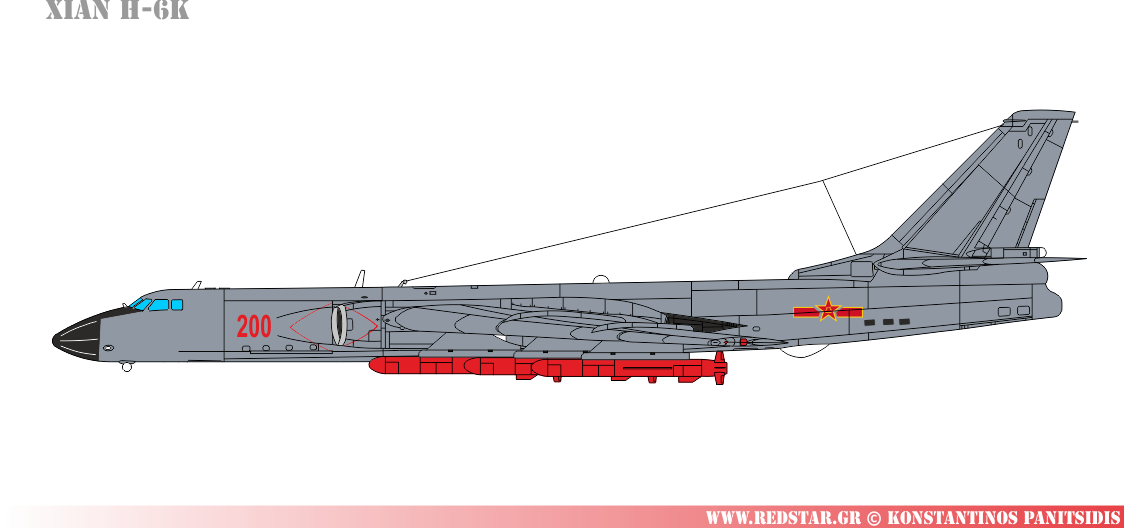
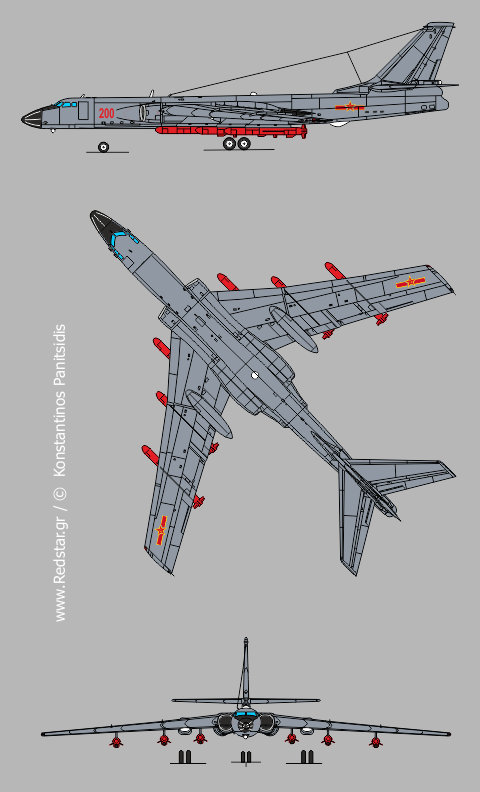
Three-view drawing
Technical specifications
| DESIGNER | Xian (Aircraft Industrial Corporation) |
| COUNTRY | China |
| TYPE |
Strategic bomber
|
| CREW | 4 |
| POWER-PLANT | Two D-30KP-2 turbofan engine |
| Thrust, kgf | 2x12.000 |
|
DIMENSIONS
|
|
|
Length, m
|
34,80
|
|
Height, m
|
10,36
|
|
Wing span, m
|
33,00
|
| Wing area m2 |
165,00
|
| WEIGHT | |
| Maximum take-off, kg | 79.000 |
| Normal take-off, kg | - |
| Empty aircraft, kg | 37.230 |
| Internal fuel, kg | - |
| Warload, kg | 12.000 |
| PERFORMANCE | |
| Maximum speed, km/h | 1.050 |
| Cruising speed, km/h | 786 |
|
Combat range, km
|
3.500 |
| Range, km | 6.000 |
| Ferry range, km | - |
|
Endurance, h
|
- |
| Service ceiling, m | 12.800 |
| Rate of climb, m/min | - |
| Maximum overload, g | - |
| ARMAMENT | Capable of carrying up to six CJ-10A missiles or C201 anti-ship missiles. |