


Author: Markos Andreou
English translation: Jonathan Ioannis McKelvey
The founder of the factory was Ioannis Gleoudis-Patestas. His life was active and creative; at a young age, he emigrated to Constantinople where he studied and worked in commercial houses. As a brilliant merchant, he returned to Kea to inherit his wealthy godfather. In 1922, refugees from Asia Minor, mainly tobacco farmers, arrived on the island. He helped them by exporting tobacco until 1927, when the government prohibited tobacco cultivation in the Cyclades.
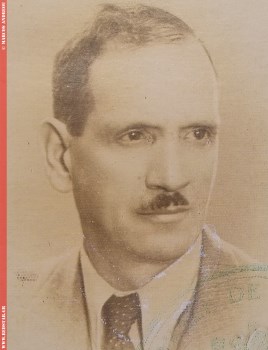 |
| The founder of the factory, Ioannis Gleoudis-Patestas. |
In 1925, along with partners who were tobacco traders and importers of enameled household appliances from Czechoslovakia—the Papadatos brothers—and the Czech technician S. Wachti of the Budweiss enamel appliance manufacturing company, they founded the Greek enamel company with the characteristic star logo.
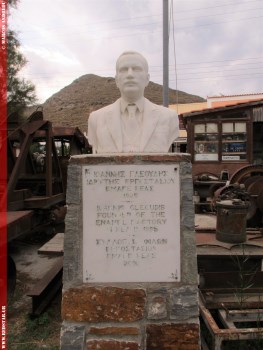 |
| The bust of Ioannis Gleoudis in the museum's outdoor area. |
Benefiting from Eleftherios Venizelos' 1920 law that allowed the duty-free importation of machinery for new corporations with capital exceeding 5,000,000 drachmas, they raised a total of £30,000 for 30,000 shares. Specifically, Ioannis Gleoudis contributed £13,000, the Papadatos brothers £8,000, and the Czech industrialist S. Wachti £9,000.
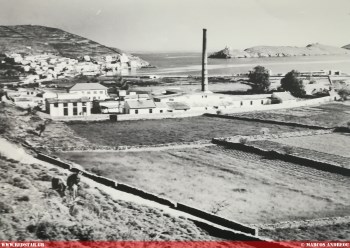
A 21-acre property owned by Ioannis Gleoudis in the plain of Korissia was selected by the Czech technician for £1,000. With the supervision of architect Achilles Karras from the Makris S.A. company and the personal oversight of Ioannis Gleoudis, the construction of the factory began, covering a total area of 8 acres.
|
| The newly built factory in the plain of Korissia in Kea. |
The factory consisted of nine sections:
1. The machine shop for the construction of all kinds of parts and the processing of tinplate items.
2. The power plant for generating electricity, with generators driven by internal combustion engines.
3. The tinplate cleaning section for enameling with acids.
4. The large hall for soldering handles, painting, and drying.
5. The goods warehouse.
6. The enamel manufacturing workshop.
7. The 45-meter chimney built by the Mathios S.A. company.
8. The carpentry workshop for the construction of wooden models for casting iron (castiron) molds.
9. The management offices.
The machinery that equipped the factory was from the bankrupt Titania Werke company of Wels in Northern Austria. They were transported by ships to the port of Kea and from there by barges to the pier, where they were moved with primitive means-winches, rollers, and levers-onto a handcart that ran along a 600-meter track to the factory for final placement on fixed concrete bases.
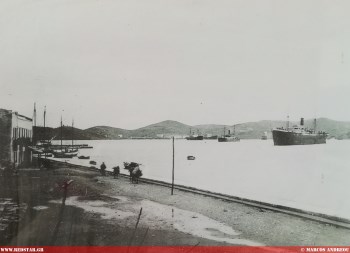 |
| The port of Kea at that time. |
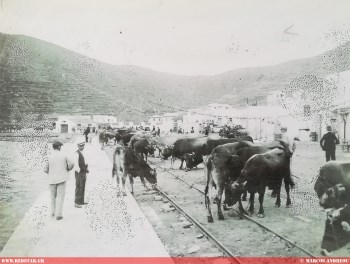 |
| The 600-meter line along which the cart moved, transporting the machinery and supplies to the factory. A market for farm animals is taking place at the moment the photo was taken. |
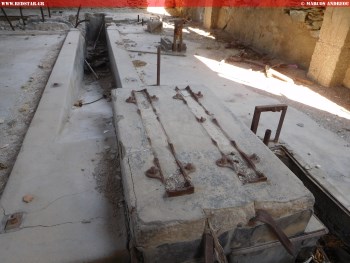 |
| A modern photo of the concrete bases where the machinery was placed in the factory. |
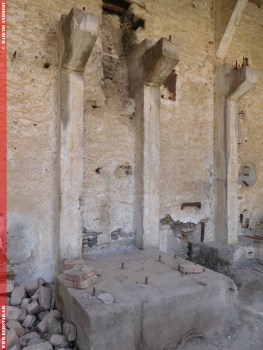 |
| The cement bases where the machines were fixed to as seen today in the factory. |
In 1927, Ioannis Gleoudis, known affectionately as Uncle Yannis, successfully overcame all the difficulties that arose and inaugurated the new factory in the presence of Eleftherios Venizelos. A large crowd of Greeks and foreigners congratulated him on his achievement!
In 1928, after training the staff, production began. The first year's production exceeded expectations, reaching 150,000 kilograms of enameled products. However, in the second year, despite optimistic forecasts, production plummeted to 17,650 kilograms.
Unfortunately, in 1930, the factory went bankrupt and closed. Having spent all his personal capital in trying to prevent the bankruptcy, Ioannis Gleoudis traveled to Poland to sell his tobacco. The factory passed into the ownership of the Syros banker Emmanouil Tsiropinas and was subsequently mortgaged to the National Bank, which rented it to Athanasios Kostas to operate it.
| THE ERA OF ATH. KOSTAS |
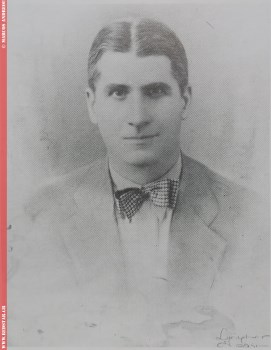 |
| Athanasios D. Kostas around 1925. |
Athanasios D. Kostas was a flour mill owner from Gallipoli, Thrace. In 1922, he settled in the Gallipoli area of Piraeus and, together with his brothers, opened a glass shop on Vissi Street, also trading in household utensils. At the same time, they became small shareholders in the enamel company.
In 1933, Athanasios Kostas reopened the enamel and metallurgy factory in Kea with a new and very capable team.
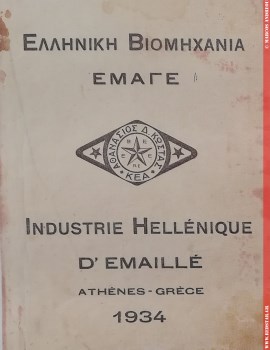 |
| Factory price list from 1934. |
General Manager was Daniel Konstantinidis, Financial Director Konstantinos Tsanavaris, and Technical Director Michail Vlados, a Greek expatriate from Russia, an electrical engineer with many years of experience in Germany, Latvia, Ukraine, and Russia. He organized the factory to European standards and achieved high production with excellent quality. The domestic market was covered, and the products began to be exported to the Balkans, Turkey, the Middle East, and Egypt.
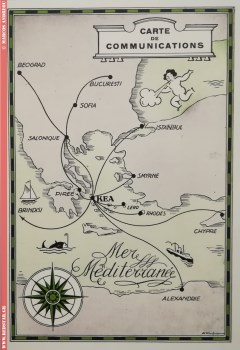 |
| The routes and destinations of the products. |
 |
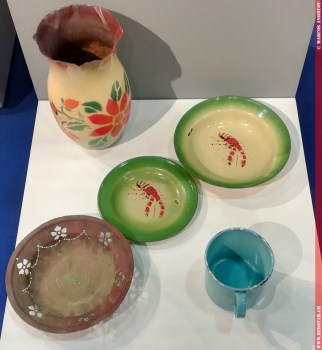 |
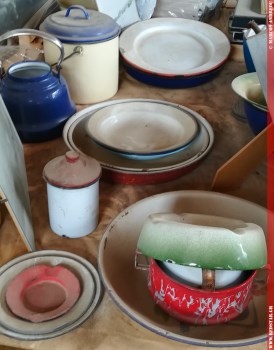
| Enameled products of the Kea factory. | Enameled products of the Kea factory. |
The goods were transported by two caiques from Kea: the "Agia Varvara" of Captain Stavris and the large caique "Evangelistria" of Captain Dimitris Rafiou. The first ran routes to Piraeus, and the second to Piraeus, Thessaloniki, Constantinople, and Smyrna. Both brought raw materials from Piraeus to Kea.
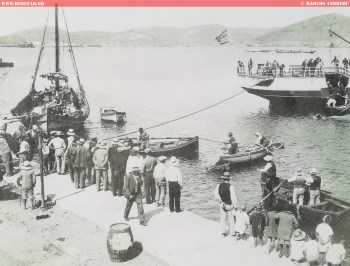 |
| The caiques (boats) at the port of Kea. |
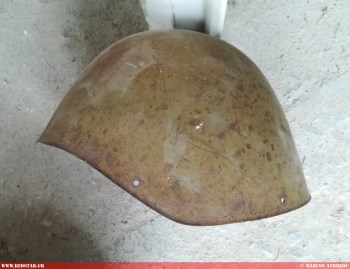
The factory began production for the Greek army, manufacturing 250,000 helmets, 250,000 aluminum canteens, and preparing to produce mortars, hand grenades, gas masks, and cooking vessels, but in April 1941, with the fall of the front, everything unfortunately came to a halt.
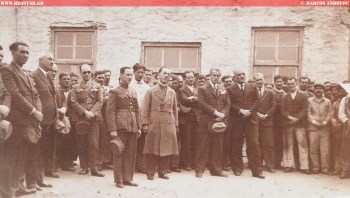 |
| Helmet delivery in 1937, Greek army officers, members of the acceptance committee, and factory delivery committee members are distinguished. |
 |
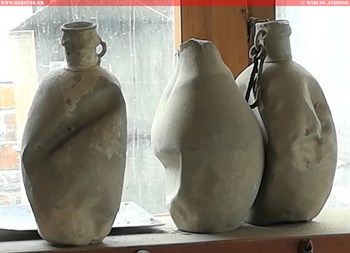 |
| A Greek helmet from the factory's production is displayed today at the museum of the Friends of Enamel Factory in Kea. | The aluminum canteens produced by the factory are exhibited at the museum; they are not in excellent condition today, but the characteristic suspension ring can be seen. The woolen khaki covers and cork stoppers are also missing. |
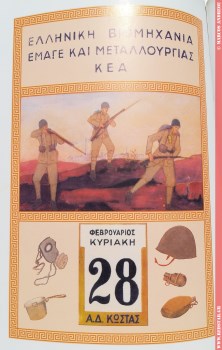 |
| Factory diary where new products being prepared for production for the Greek army are visible. |
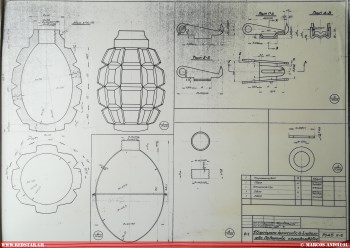 |
| Factory plans depicting the Polish wz.33 offensive and defensive hand grenade designs that were to be manufactured. |
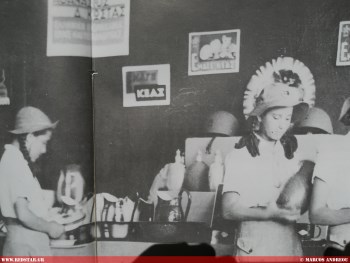 |
| Photo of the factory's booth at the Thessaloniki International Fair, unknown year. Canteens and helmets made for the Greek army are visible. The black-painted national emblems on the front of the helmets are particularly noteworthy. |
During the occupation, the factory operated on a reduced scale, but after liberation in 1945, with Athanasios Kostas having bought all the company's shares, production started again under the new brand name EMAKOST.
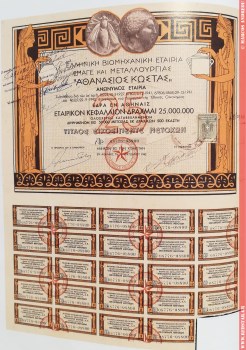 |
| Shares of Athanasios Kostas's company. |
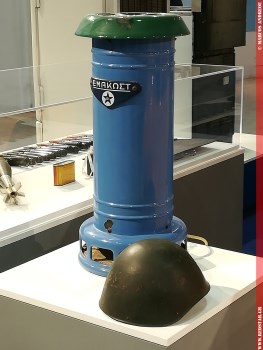 |
| Enamel stove under the new brand EMAKOST of A. Kostas. Photo from March 24, 2018, at the exhibition of Greek industry held at Gazi, Athens. |
For the Greek army, since supplies were now sourced from England and America, it produced only new type aluminum canteens with screw caps instead of corks and digging tools. It also added new products such as forks, spoons, knives, stoves, burners, electric stoves, hurricane lamps, and more.
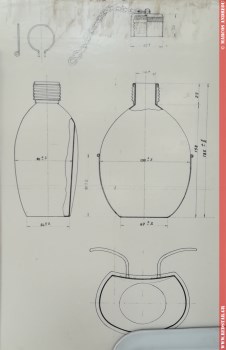 |
| The post-war aluminum canteen designs found in the museum. |
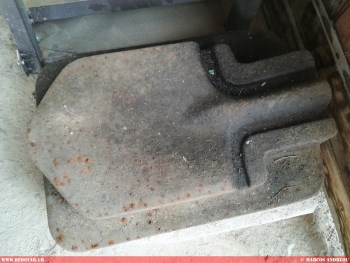 |
| The cast iron mold for a Greek army digging tool. |
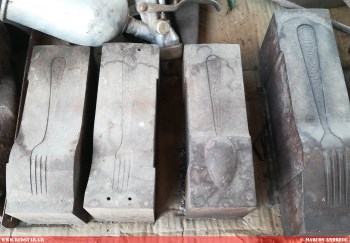 |
| Molds for cutlery preserved today in the museum, thanks to Mr. I. Evgenikos. |
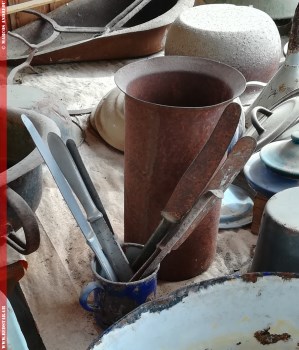 |
| Household knives produced by the factory. |
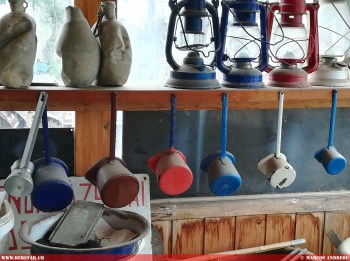 |
| Various enamel products from the factory. |
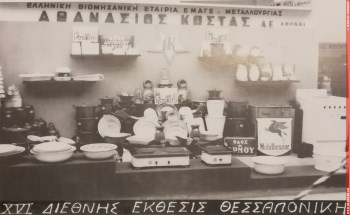 |
| Photo of the factory's products at the 16th Thessaloniki International Fair in 1951. |
Everything was going well, but the death of Athanasios Kostas in 1957 and the inability of his heirs to continue his work led to the closure of the factory. In September 1961, oil entrepreneur Stylianos Restis bought the factory at auction and began purchasing raw materials to operate it. Unfortunately, his sudden death thwarted the attempt to restart the factory. Subsequently, at the same time, the company VIOSMALT Ltd., founded by workers from the Kea factory, attempted to develop their company by negotiating with the widow, Mrs. Lina Restis, to buy the factory, but to no avail.
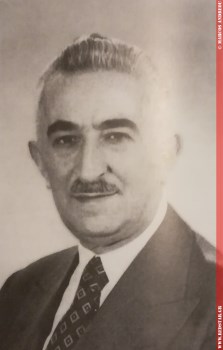 |
| Stylianos Restis. |
Thus ends the thirty-year operation of the enamel and metallurgy factory of Kea, 1927-1957, by Ioannis Gleoudis-Patestas and Athanasios D. Kostas. Today, everything is still there, left to the mercy of time and the inactivity of the state.
It is worth mentioning the significant and invaluable work of the Friends of the Enamel Factory Association, supported by Mayor Nikolaos Demenagas, as well as the contribution of ordinary people who, with pure love, protect the island's history and help as much as they can!
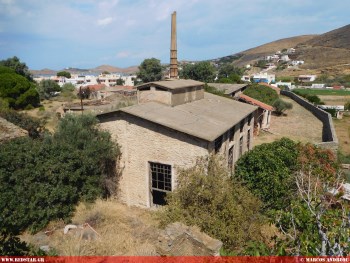 |
| The factory today. |
Special mention should be made of the effort and daily work of Mr. Ioannis Evgenikos, who, at the age of 94, is still struggling to preserve what remains. Without the contribution and help of Mr. Ioannis Evgenikos, we wouldn't have in our hands this precious historical material!
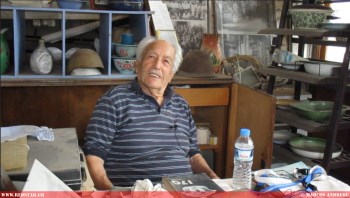 |
| Mr. Ioannis Evgenikos in the museum of the Friends of Enamel Factory Association, which he maintains in Kea. |
Photos The Enamel and Metallurgy Workshop of Kea


